One of my most frequently asked questions on this blog is how to become a dietitian.
You might be confused (like I was) about how it all works, especially if you are starting from scratch with the prerequisites, and don’t already have a nutrition undergraduate degree.
Many of you seem to be in the same boat that I was in 2009. After getting an unrelated undergraduate degree and years of office work in an unrelated field, I decided to make a career out of nutrition.
I’m honored to know that I’ve inspired some of you to follow your own dreams, and happy to be able to help you out along the way!
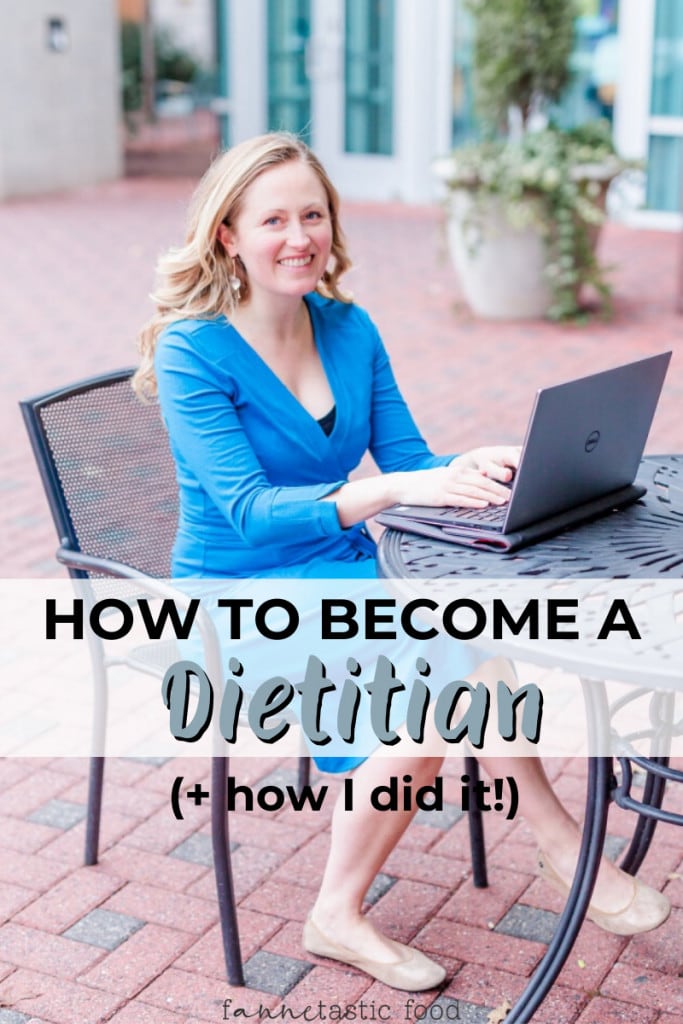
Here is my step by step guide to becoming a Registered Dietitian. I hope it’s helpful!
 **Just a note: I do not work for the Academy of Nutrition & Dietetics, and I won’t be able to answer any questions you have specific to your own back to school to become an RD journey. Please don’t email me with those sort of technical questions!

 If you’re interested in started your own practice, please check out this post: How to Start a Nutrition Counseling Private Practice.
I counsel clients using an approach called Intuitive Eating. We work together to improve their relationships with food in a way that has them eating food that makes them feel good, but still allows for indulgence, too.
If you’re interested in learning more about intuitive eating, check out this book: Intuitive Eating: A Revolutionary Program That Works.
I also taught the Basic Nutrition course to undergraduates at The George Washington University in DC in the spring of 2013. And, I’ve developed a Nutrition for Runners Program with a running coach and a 6 Week Virtual Intuitive and Mindful Eating Program with other RDs who specialize in intuitive eating.
I either work from home or out of a co-working space, and my days are mostly a mix of computer work (blogging, client research/follow ups, freelance writing, emails) and client meetings (both in person at a coffee shop, and via phone or Skype).
If you’re interested in started your own practice, please check out this post: How to Start a Nutrition Counseling Private Practice.
I counsel clients using an approach called Intuitive Eating. We work together to improve their relationships with food in a way that has them eating food that makes them feel good, but still allows for indulgence, too.
If you’re interested in learning more about intuitive eating, check out this book: Intuitive Eating: A Revolutionary Program That Works.
I also taught the Basic Nutrition course to undergraduates at The George Washington University in DC in the spring of 2013. And, I’ve developed a Nutrition for Runners Program with a running coach and a 6 Week Virtual Intuitive and Mindful Eating Program with other RDs who specialize in intuitive eating.
I either work from home or out of a co-working space, and my days are mostly a mix of computer work (blogging, client research/follow ups, freelance writing, emails) and client meetings (both in person at a coffee shop, and via phone or Skype).
Want to save this post?
Enter your email below and get it sent straight to your inbox. Plus, I'll send you great content every week!
How to Become a Registered Dietitian (RD)
The process sounds scary and complicated, but it’s really not when you understand it. And it will definitely be worth it – it was for me! Here’s everything you need to know about going back to school to become an RD, right on one easy page. I wish I’d had this on hand when I started my own journey! 🙂To become a dietitian, you need to do 3 things:
- Take the specific set of courses outlined by the Academy of Nutrition & Dietetics (AND). This can be completed at the undergraduate OR graduate level as of now, but starting in 2024 a graduate degree will be required to sit for the RD exam.
- Complete the required internships, also outlined by AND. This can be done separately or at the same time as the coursework, depending on your program. (See the researching programs section for more details).
- Take the RD exam (and pass it!).
Steps for Applying to School to Become an RD:
- Research programs. Online options are available as well as in person.
- Take the GRE (if applying at the graduate level).
- Take the required prerequisites. (This can be done online, or at a community college to save money.)
- Apply to your chosen programs. (This can be done while finishing prerequisites. I was only half way through when I applied!).
- Get accepted to the school of your choice and rejoice!
1. Research Registered Dietitian Accredited Programs
The first thing you should do if you want to go back to school to become an RD is to research the offered programs. Click here to view AND’s accredited programs. You can narrow it down based on location, whether it’s graduate or undergraduate, etc. As of now you can do the coursework at either the undergraduate or graduate level. But, as I mentioned, starting in 2024, a graduate degree will be required to sit for the RD exam. Since I already had a bachelors degree, I choose to apply to only graduate programs. (There are also a few online-based programs, but I don’t know anything about those because I didn’t research them personally.) Coordinated programs mean you do the coursework AND internship all at once, in one program. If it’s a coordinated masters program, it will typically be 2 to 2.5 years. The MPH-Nutrition program at UNC (where I went) is like this, so our internships were set up for us and dispersed throughout the 2.5 years of school. (This happened in the two summers in between classes, and in the final fall semester). Didactic coursework and internships, on the other hand, means you complete the coursework and the internships separately. You’ll have to apply to both programs separately as well. I would recommend applying to coordinated programs if possible, as internship programs in particular can be hard to get into. Hot tip: if you need help with the internship application process, check out All Access Dietetics – they have a Get Matched Course that I’ve heard is really helpful! Use my affiliate code FANNETASTICFOOD for 20% off the Get Matched Course (pay in full option).2. Take the GRE (if you are applying at the graduate level)
Enough said. You’ll be fine — just buy a study guide book and use it. 🙂 Especially for the math and vocabulary sections! I recommend this study book (affiliate link) from Kaplan.3. Take the Required Prerequisites to Become a Dietitian
Most of the prerequisites (at least for the MS and MPH programs I looked at) are similar, although there are a few higher level differences, which is annoying. I took the courses I knew I absolutely needed first. I saved the last one or two for the summer before I started, when I would know which program I was attending. (You don’t have to have all the prereqs finished when applying to programs. You just have to indicate how you plan to complete all the prereqs by the time the program starts.) To save money, these prereqs can be taken online or at a community college. To determine the exact prerequisites you need, check the websites for the programs you are interested in, or call their admissions office.Prerequisites You’ll Definitely Need to Take:
- Chemistry 1 + lab
- Chemistry 2 + lab
- Biology 101 + lab
- Organic Chemistry + lab
- Anatomy & Physiology + lab (you’ll definitely need A&P 1, and you might also need 2)
- Human Nutrition (or something similar — an intro to nutrition)
- Intro Biochemistry
- Microbiology
- Intro to Psychology
- Intro to Sociology
- etc.
4. Apply to Your Chosen Program to Become a Registered Dietitian
Most applications are due sometime between December and February to start the following fall. It’s fine to apply to schools before you’re done with the prerequisites. You’ll just send updated transcripts as you complete courses. When I applied to schools, I had only completed about half the prerequisites. So I just outlined my plan for completing the rest (e.g. I will take these courses in the spring and these courses in the summer) at the end of my personal statement.5. Get Accepted and Rejoice!
You did it! Time to get out there and start changing the world. 🙂 I hope you guys found this helpful! I remember it being kind of a nightmare trying to figure all this out on my own, so hopefully I’ve spared some of you the same fate.Is a Nutritionist the Same thing as a Registered Dietitian?
No! A Registered Dietitian (RD), or Registered Dietitian Nutritionist (RDN), has to go through years of science-based schooling, many hours of technical internships, and pass a national exam. Anyone can call themselves a “nutritionist” – it doesn’t mean much except that the person may have taken a short online course. One more thing: RD and RDN is the same thing. Interchangeable. In case you were confused. Also, it’s spelled dietitian with two T’s, no C! Lastly, I want to give a shout out to my friend and fellow dietitian blogger Kath, who was really inspirational to me on my journey to become an RD as she did it a couple years before me! Here’s her blog post on the topic which you may also find useful: The Makings of a Registered Dietitian.Update on My Path to Becoming a Dietitian
After how to become a dietitian, the second thing I have been getting TONS of emails about is follow up questions for me now that I’m actually an RD. I’m happy to answer your questions, but as my email inbox is completely out of control, here is some information that might answer the questions you have. Please check this out before emailing me. 🙂Info specific to my masters program + internships:
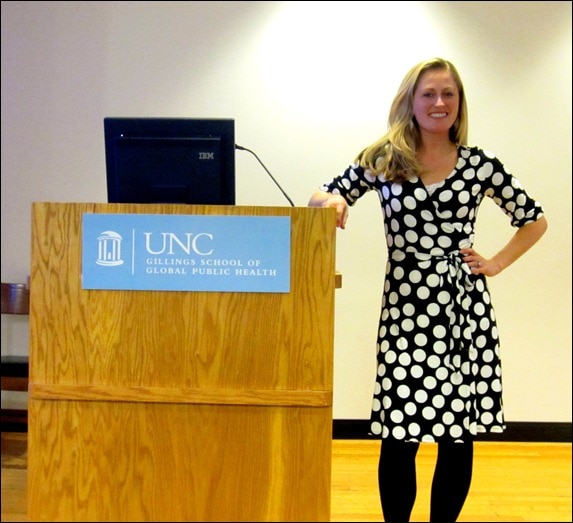
I started my Masters of Public Health in Nutrition from UNC-Chapel Hill in the fall of 2010. I graduated in December 2012 after completing the coursework, internships, and writing/presenting my masters paper. An MPH-RD program is basically a Masters of Science in Nutrition plus extra public health coursework (about a semester worth) so that we got the MPH-RD instead of an MS-RD. So, we didn’t take any less science classes than an MS-RD program would require. I loved UNC and highly recommend it. I really miss Chapel Hill, too – here’s a post all about my time there.
Dietetic Internship Details
Here’s more information on what I did for my internships. These internships were done during/as part of UNC’s program, since it is coordinated. I don’t know anything about the separate formal internship application process since I didn’t do it, but if you need help with the internship application process, check out All Access Dietetics – they have a Get Matched Course that I’ve heard is really helpful! Use my affiliate code FANNETASTICFOOD for 20% off the Get Matched Course (pay in full option). If you are doing a program where you find your own internships, or if you want some volunteer experience before applying to programs, check out preRD.org – they connect nutrition students to dietitians that can provide mentorship and/or volunteer, internship, and job opportunities.Dietetic Internship #1:
I spent the first summer (2011) between classes doing my community/public health rotation at the NC Cooperative Extension. Here’s a post about one of my days there: A Day with the NC Cooperative Extension. We taught cooking classes for kids, led community events, taught adults about hypertension and eating healthy, made healthy eating materials (see How to Make a Recipe Healthier), and more. It was a lot of fun!Dietetic Internship #2:
My second summer (2012) internship was clinicals, where we all interned in hospitals. Most of my classmates interned in NC, but I was able to come back up to DC to intern at Washington Hospital Center. I wrote a little about it in this post: First Week at My Hospital Internship!Dietetic Internship #3:
My final internship was in the fall of 2012, and we were able to basically create our own internship. (Your third internship in a Masters of Science program is normally a food service rotation, but since I was in a Masters of Public Health Nutrition program, it was different) Classmates did a variety of things, interning in hospitals, at public health organizations, food service, etc. I broke mine into three mini-internships and interned with a corporate wellness organization and two private practice dietitians, all here in the DC area. You can read more about my corporate wellness internship in this post. Interning with private practice RDs was really helpful when it came to starting my own practice later!What I’ve been up to since becoming a Registered Dietitian
Ever since graduating, I have been working for myself full time. I do a combination of nutrition counseling, blogging, and freelance writing and nutrition corporate presentations. (I contract with corporate wellness companies to do these). You may be interested in this post: How to Start a Blog on Wordpress. As well as this post: How to Make Money as a Blogger. After I studied for and took the RD exam in February 2013 (more details on how I studied: how to pass the RD exam), I started my own nutrition counseling private practice here in the Washington DC area (www.AnneTheRD.com).
If you’re interested in started your own practice, please check out this post: How to Start a Nutrition Counseling Private Practice.
I counsel clients using an approach called Intuitive Eating. We work together to improve their relationships with food in a way that has them eating food that makes them feel good, but still allows for indulgence, too.
If you’re interested in learning more about intuitive eating, check out this book: Intuitive Eating: A Revolutionary Program That Works.
I also taught the Basic Nutrition course to undergraduates at The George Washington University in DC in the spring of 2013. And, I’ve developed a Nutrition for Runners Program with a running coach and a 6 Week Virtual Intuitive and Mindful Eating Program with other RDs who specialize in intuitive eating.
I either work from home or out of a co-working space, and my days are mostly a mix of computer work (blogging, client research/follow ups, freelance writing, emails) and client meetings (both in person at a coffee shop, and via phone or Skype).